Curved Treadmill Guide for Gym Owners in India
By Skelcore India
A curved treadmill is the one treadmill in your gym that does not need a power point. If you have been thinking about adding a curved treadmill to your floor, this is what we tell gym owners who ask us about it.
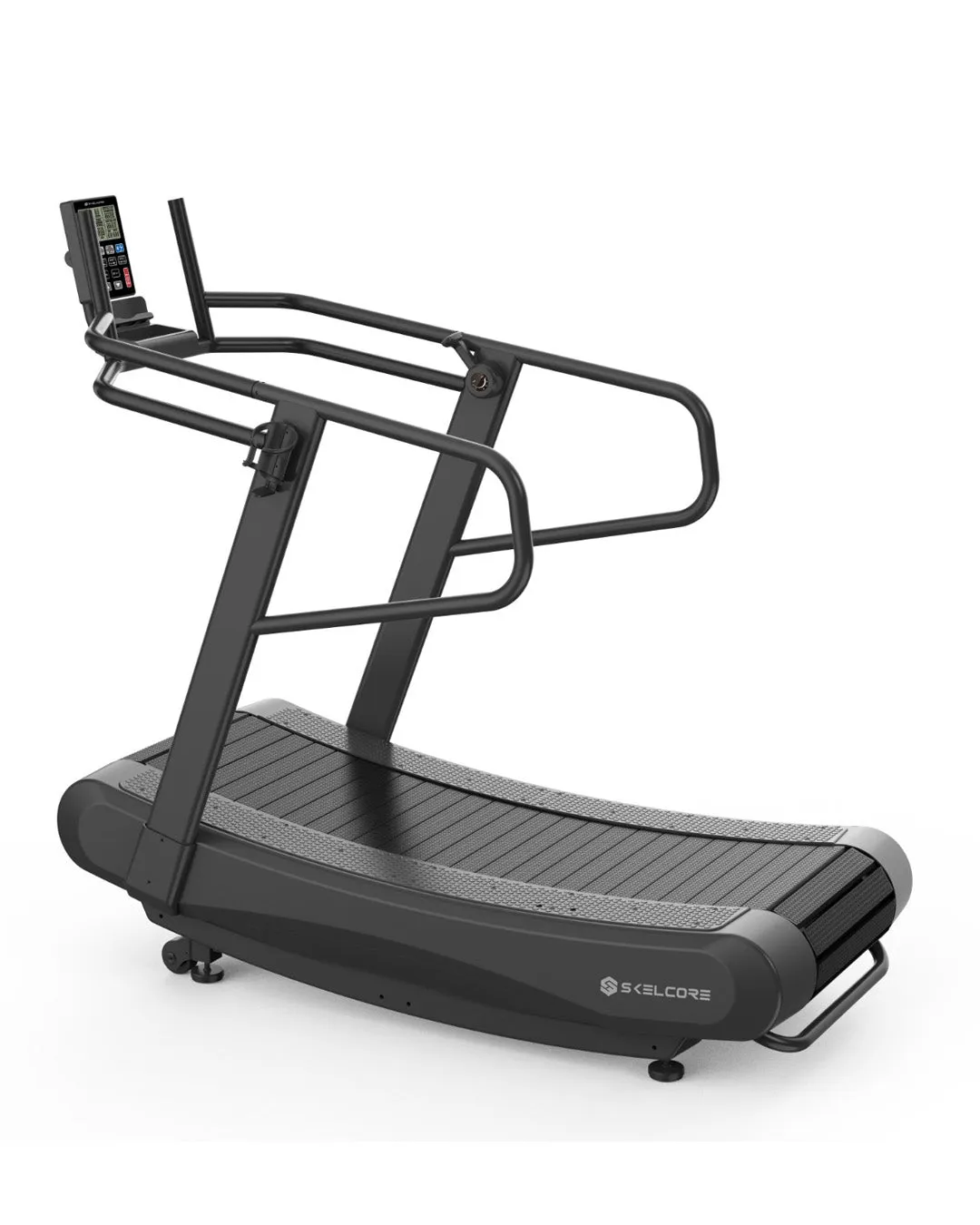
The belt is curved like a shallow bowl and is made of slats. There is no motor. You push the belt back with your own feet, and it moves only as fast as you make it move. Stop pushing and it stops.
That one difference changes who uses it, how it feels and where you can place it. Our HIIT range has two curved models, and we will go through both below.
How a curved treadmill differs from a normal one
On a regular motorised treadmill, you set a speed and the belt carries you along. You keep up or you fall off. On a curved treadmill, you decide the speed. Lean forward and you move up the curve, and the belt speeds up. Ease back and it slows down.
This sounds like a small thing, but members feel it straight away. The run is harder because every step is work, with no motor helping. Many members find the stride feels closer to running outdoors.
Here is a quick side-by-side:
Point | Curved treadmill | Motorised treadmill |
|---|
Power | None. The runner drives the belt | Needs a power connection |
Who sets the speed | The runner, step by step | The console or the user |
Best use | Sprints, intervals, conditioning | Steady running, walking, all-day member use |
Beginners | Can feel hard and unfamiliar at first | Easy to learn |
Incline | Fixed by the curve | Usually adjustable |
Placement | Anywhere there is floor space | Near a power point |
So a curved treadmill is not a replacement for your regular treadmills. It is an addition, for a different kind of training.
Who should buy a curved treadmill
Buy one if you run group classes, personal training or a conditioning area. Sprint intervals such as 20 seconds hard and 40 seconds easy suit it very well. Because the runner controls the pace, nobody gets left behind by a belt that is too fast.
It also makes sense for a functional training zone, next to sleds, ropes and air bikes. If you are building that kind of area, see how it fits with the Air Bike in the same corner.
Skip it, or buy just one, if your members are mostly older walkers or complete beginners. They will go to the regular treadmills anyway. A curved machine sitting unused is wasted floor space.
A simple rule we give owners: for every ten motorised treadmills, one curved treadmill is plenty to start with. A small studio may only want one in total.
The power cut advantage
This is where curved treadmills help in India. There is no motor and no electricity needed, so the machine works during a power cut. It also works in a corner where nobody planned a socket.
Think of a hotel gym on an upper floor, a corporate gym in a converted room, or a studio with a low electricity load. You do not need to run extra wiring. [TODO: confirm how the LCD console is powered on both models]
Our two curved treadmill models
We stock two. Both are built for HIIT and conditioning, and both use a curved deck with magnetic tension to control how hard the belt is to push.
SK6000 Curved Free Running Treadmill
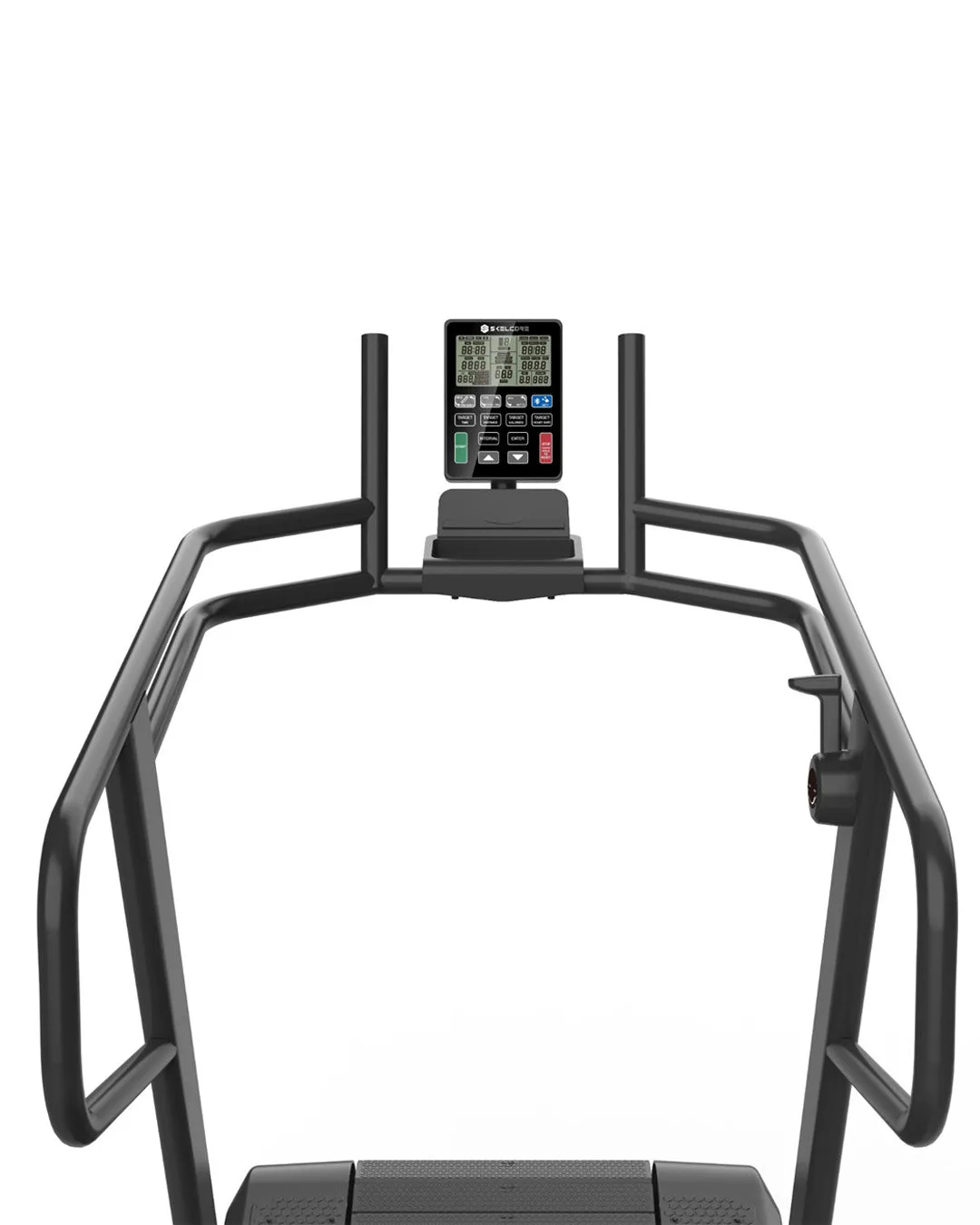
The SK6000 Curved Free Running Treadmill is the simpler of the two. It takes users up to 170 kg and has four levels of magnetic tension. The console has seven workout modes, including custom intervals, and you can tilt it to a comfortable angle.
It takes up about 1780 x 870 mm of floor, and it is around 1730 mm tall. It has two transport wheels, so one person can move it when you rearrange the floor for a class.
Curved Runner 3.0
The Curved Runner 3.0 takes users up to 200 kg. It is slightly smaller, at about 1710 x 860 mm. The console shows time, distance, calories, watts, pace, speed and pulse.
The extra feature is a resistance setting for sled-style pushing. With it, a trainer can set the machine so the runner has to drive hard against the belt, like pushing a sled. That is useful if you do not have the floor space or turf for a real sled.
Which one should you pick?
If you have heavier members or you want sled-style work, take the Curved Runner 3.0. If you want a straightforward machine with clear interval modes, take the SK6000. For most gyms the difference will not decide the sale. Pick the one that matches your training style.
Where to place it
Leave room behind and around it. A runner who loses balance needs a clear space, so keep at least a metre free at the back and keep the sides away from other machines.
Check the ceiling too. The SK6000 stands about 1.73 metres tall and the runner is standing on top of the deck, so plan for a head height well above that. Most gyms are fine. A basement studio with a low false ceiling needs a measuring tape before ordering.
Do not mix curved treadmills into your row of regular ones. Put them in your conditioning area, where members expect hard, fast work and a bit of noise.
Care and running costs
With no motor, there is no motor to service and no electricity bill for the machine. That keeps running costs low. What you do need is a regular routine:
Wipe the handrails and grips after each session.
Check the belt drive, deck and bolts once a month and tighten anything loose.
Keep dust and debris out of the slats so the belt turns smoothly.
Treat it like any heavy-use machine. Put a note in your daily floor checklist and it will stay in good shape.
What does it cost?
Price is on request. We quote each order separately because the final amount depends on the model, the number of machines, delivery to your city and installation. Taxes are extra. Send us your floor size and we will quote for the whole package, not just one machine. [TODO: confirm lead time for delivery and installation]
Do you still need motorised treadmills?
Yes. Most members want to walk or jog at a steady pace for 30 minutes, and a curved belt is tiring for that. Keep a row of regular machines such as the Black Series Treadmill 6.0 for them. It has a 6 HP AC motor, a 21.5-inch screen and a speed range of 1 to 25 kph, and it handles long hours on a busy floor.
Then add one or two curved machines for the members who like to train hard. You get the best of both. You can also see the whole cardio range before you decide on the mix.
Talk to us before you buy
Tell us your floor size, how many members you expect and what kind of classes you run. We will suggest how many curved treadmills make sense and where to put them. Request a quote and we will get back to you.
Equipment in this article